Posts

3ds Max is not something a real estate agent should have to think about. It is Autodesk software, it costs more per year than plenty of agents spend on marketing, and nobody is suggesting you learn it.

3ds Max branding banner

You hear the name anyway, because it sits behind a lot of the staging photos you order. And the choice your vendor makes between that program and Photoshop decides what you can ask for later, how the shadows land in the picture, and whether a second angle of the same room costs you anything.

What 3ds Max Is, And Why A Realtor Ever Hears About It

It is 3D modeling and rendering software from Autodesk, the same company behind AutoCAD. Architectural visualization studios lean on it heavily, and staging is really just archviz pointed at a smaller room, which is how the name ended up in real estate.

One detail worth knowing, because a lot of older articles get it wrong: 3ds Max runs on Windows only. There has never been a Mac version. If somebody tells you they stage in 3ds Max on a MacBook, something in that sentence is off.

The renderer that ships with it is Arnold, though most studios doing interiors reach for V-Ray or Corona instead. That part genuinely does not concern you. What matters is what the tool lets the artist do with your photo.

The Real Difference: 3D Models Or Cut-Out Photos

Photoshop staging works with photographs of furniture. Somebody finds a sofa on a stock site, cuts it out, drops it into your room photo, scales it until it looks about right, then paints in a shadow by hand.

Living room staged with 3D furniture models in 3ds Max

3ds Max staging works with 3D models. The artist rebuilds your room as geometry, places modeled furniture inside it, puts a light source where your window is, and lets the software work out where every shadow falls.

That is the entire difference. Everything below comes out of it.

What The Model Buys You In A Listing

Shadows that agree with the window. When the light is calculated rather than painted, the sofa throws its shadow in the same direction as the coffee table and the lamp. Buyers do not consciously check this. They just feel that something is wrong when it is wrong.

Classic living room render where every shadow follows the window light

A second angle without starting over. The room exists as a model, so the artist moves the camera and renders again. In Photoshop there is no room, only one flat picture, and a different angle means finding every piece of furniture again shot from that exact viewpoint. Usually it means the answer is no.

Open plan living area staged in 3ds Max

Proportions you can defend. Furniture models carry real dimensions. A sofa that is 84 inches wide stays 84 inches wide against your walls, so the photo does not quietly oversell how much floor you have.

Kitchen render with cabinets and island at true dimensions

Tours, video and sliders from the same scene. Once the room is built, a 360 tour or a walkthrough clip is extra render time rather than a separate project. Here is one rendered from a staging scene, so you can see what a buyer gets to click through.

Revisions that cost an afternoon. Swap the grey sectional for leather, change the rug, drop in a nursery instead of an office. The scene is already there.

  • Before-Virtual Renovation
    After-Virtual Renovation
    Before Virtual Renovation After

Where Photoshop Is Still The Better Tool

Photoshop is not the loser here, it is a different job. When something has to come out of the photo rather than go into it, Photoshop is the right tool and 3D artists use it constantly.
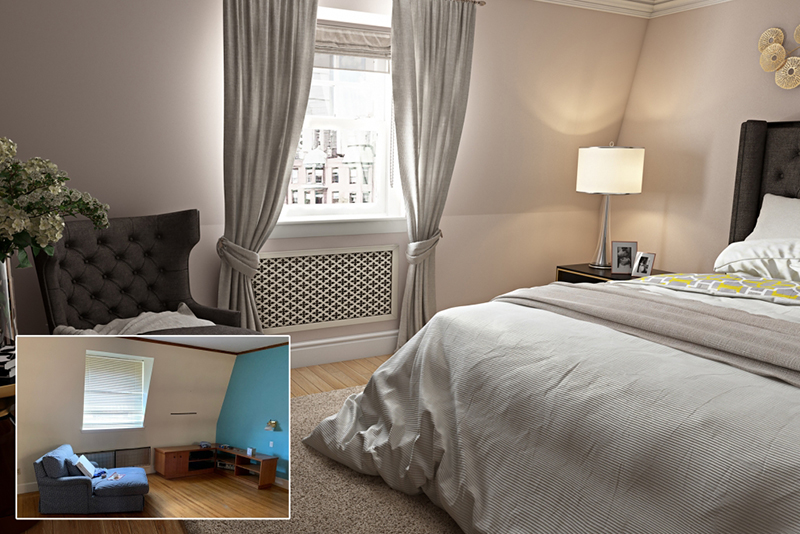
Cluttered bedroom cleared and restaged, with the original photo inset

Removing a stain, a crack, a stray cable. Clearing a cluttered room so it can be staged from scratch. Changing a wall color, fixing a blown-out window, cleaning up the yard. Most staging jobs on a furnished property start in Photoshop and only then move into 3D. If you are weighing the two methods for a specific listing rather than for your whole pipeline, the case by case breakdown lives in virtual staging vs Photoshop.

How To Tell Which One Your Vendor Used

Ask for a second angle of a room they already staged. A studio working in 3D will send it. A cut-out job cannot produce one without redoing everything.

Empty open plan living area staged in 3D, with the original photo inset

Look through their portfolio for the same sofa. Stock furniture photos are a limited pool, and the same three sofas turn up across a dozen listings when someone is working from cut-outs.

Check where the shadows point. Pick any staged photo and follow the shadow of every object back toward the light. If two of them disagree, that shadow was painted.

Look at the glass. Reflections in windows, mirrors and glossy tabletops are the hardest thing to fake by hand, so they are usually just missing.

The Cheap Offer Problem

Photoshop staging is cheap to attempt. The software is common, the machine does not need to be powerful, and basic skill is easy to claim. That combination produces a steady supply of very low quotes.

Classic bedroom staged for a high end listing

Two things happen with those. The images come back flat and slightly off, which is worse for a listing than an honest empty room. Or the portfolio you were shown was never theirs, and you find out after paying.

The fix is not paying more for its own sake. It is asking for one thing before you order.

What To Ask Before You Order

Send the actual photos of the room and ask what they would do with it. A real studio answers with specifics: this window is blowing out, this angle hides the corner, we would need a shot from the doorway.

Modern bedroom render delivered to a realtor

Ask what happens if you want a change after delivery, and how many rounds are included. Ask whether they can give you a 360 tour of the same room later. Ask them to send the original photo next to the staged one.

None of these questions require you to know anything about 3ds Max. They just separate the studios that built your room from the ones that pasted furniture onto it.


The software is the vendor’s problem, not yours. What reaches your listing is either a room that was rebuilt or a photo that was pasted on, and the difference shows up the moment you need something more than the one image you were sent.

Got an empty listing and no idea which you have been buying? Send us the photos and we will show you the room furnished. Our virtual staging services start there.

3ds Max Virtual Staging FAQ

Is 3ds Max virtual staging better than Photoshop?

For furnishing an empty room, yes. The furniture is a 3D model in a rebuilt room, so the lighting is calculated instead of painted and you can get a second angle later. For pulling something out of a photo, Photoshop is the better tool and studios use both on the same job.

Does 3ds Max run on Mac?

No. It is Windows only and always has been. Studios on Apple hardware either run Windows on a separate machine or work in different software.

Do I need to know 3ds Max to order virtual staging?

Not at all. You send photos and a note about the style and the buyer you are aiming at. The software matters only because it decides what you can ask for after delivery.

Can 3ds Max staging remove furniture that is already in the room?

Yes, though the removal step usually happens in Photoshop first. The old furniture is cleared, whatever it was covering gets reconstructed, and the empty room is then staged in 3D. It costs a little more than staging a genuinely vacant space.


7 Trends in Real Estate

The median existing home sold for 440,600 dollars in June 2026, the highest figure NAR has ever recorded. Sounds like a great time to be an agent, until you look at the rest of the picture. Sales slipped 2.4% that month, mortgages sit near 6.7%, and buyers take their time because everything costs more than it did a year ago.

Fewer deals and more agents chasing them means marketing decides who eats. What follows are seven habits that consistently separate the agents who keep closing from the ones waiting for the phone to ring.

#1. Discover Your Niche

Target Marketing on Facebook

Focusing on a single market niche may seem limited and unpromising at first. However, the better you understand the risks, long-term goals, and benefits that the marketing area can bring into the business, the easier it becomes to transform it into a successful project.

Real estate agents that are well aware of all the pros and cons of the niche can form effective strategies that help their business thrive. For instance, if you know that there is a new school to be built in the area, you can use that as a special feature of the offer to attract more clients with kids. Thus, determining who your target audience is and what their needs make it twice as easy to build an effective strategy.

#2. Build a Recognizable Brand

Promo items for real estate: Business cards

Apart from the niche and the audience, it is essential to make the brand recognizable. Surely, it may require some time and effort spent on the brand name and logo development, not to mention financing the whole process, but the investment will be worth it in the long run, that is for sure.

When your brand is visually recognizable, it is vital to consistently support this status. If it is a luxury property that you are offering, then the tone of the marketing content should correspond to that.

Besides, every element of the brand should complete one another, starting with your social media and ending with real estate brochures. The successful brand’s components tell the same story, and that is what attracts the customers the most. Think Brown Harris Stevens or Century 21 to get a better idea of how effective and consistent branding should look when it comes to the real estate market

#3. Plan a Marketing Budget

A Budget for Facebook Ads

Successful promotion of real estate always involves a fair share of personal investment. Without it, you can’t hope to make the business flourish. However, at times your budget is limited, and you need to make the most of what you can afford. In times like this, a realtor needs to realize that marketing in real estate depends upon the area as well as the audience that you are trying to get to.

Selling luxury homes in the New York suburbs is different from advertising property in a rural area. The first case should involve a lot of digital marketing and innovative technologies, while the latter needs an old-school approach like outdoor and print advertising. Naturally, the budget involved in the campaigns will be different. So, when planning your budget, make sure to distribute money smartly and according to your goals. 

#4. Share Your Knowledge

SEO for a Real Estate Website

These days ads are becoming more annoying than useful. That is why if you are willing to sell what you offer, you should come up with an alternative approach. While the majority of the online community is fed up with advertising, creative and useful content is in high demand.

As you may already know, personal blogs are gaining vast popularity nowadays. If you choose to promote your real estate business through a personal blog, you will kill two birds with one stone. You are going to share useful information with the interested in the property market audience, and you will also promote the services you offer.

It is necessary to state that no matter how attractive, informative, and functional your website is, it should also be mobile-friendly. Recent researches indicate that as much as 61% of real estate and other sites are viewed from mobile devices. When a website is not compatible with the mobile version, you may lose as many as half of your potential customers, and that is a significant amount.

#5. Adapt to Social Media Trends

360 camera virtual tour: Instagram

Social media stopped being optional a while back. Three quarters of agents are on it, and it now brings in more leads than any other tool they use, ahead of CRM systems and even the local MLS.

What separates accounts that work from accounts that just exist is usually patience. Post a listing, demand an email in return, watch nobody bite. Show the neighborhood instead, the renovation, the before and after of a tired living room, and let people come to you. The content has to be worth stopping a thumb for, and a furnished room does that far more reliably than an empty one with a price tag on it.

#6. Use Real Estate Staging

Offering luxury real estate without furniture in it is a common practice but surely not an entirely advantageous one. When potential customers observe the property, they can only imagine what it’s like to live in it. It seems impossible without physical staging added to the scene. Even so, while real-life staging is a practical and working trend, it is usually a costly one. That is why the modern real estate market is inclined to adopt virtual staging instead.

It is not a secret that Virtual Reality as well as Augmented Reality are in high demand at the moment and virtually staged homes fit right into it. Virtual staging is not only about furniture replacement or room design, it offers the possibility to create an appealing landscape around a property too. What is more, the service is a lot less costly than physical staging and comes with almost unlimited room for experimentation.


Here is the part most agents skip. Buyers are older and pickier than the listing copy assumes: the median one is 59, and the typical first-timer is 40. They are not counting bedrooms for a growing family. They are looking at a photo and quietly deciding whether the room works for how they actually live.

#7. Provide Regular Updates 

Outsource Services for Real Estate

Among all of the practical marketing tools, monthly newsletters have proved to be the most effective ones. It is never a waste to let your customer base know about the freshest updates of the real estate listings as well as some other relevant information such as recent sales and seasonal tips.

Besides, with such a regular update, you will keep the brand on the top so that even those who haven’t cooperated with you yet will recognize it. While many agents rely on electronic newsletters mostly, print ones aren’t obsolete yet. So, if you are willing to cover a larger audience, including the elderly population, you can combine the two.

Running a successful real estate business may not be the simplest task to complete. However, if you choose to follow the recent trends and adapt the marketing technologies that have proved to be effective, there is a huge chance of becoming the leading expert in the real estate market. The creation of a recognizable brand and logo, mobile-friendly website, and engaging content shared for free is the point that attracts potential clients’ attention. What’s more, such advanced tools as virtual staging can help hold the attention of prospects long enough for them to imagine a life in that dream house you are willing to sell.

Would you like to conquer the real estate market and get to the top of the industry? Let’s implement the most recent trends in your business together! ArchiCGI team knows how to provide breath-taking virtual staging services for all types of property. All you need to do is to contact us, and we can promise that your sales will sky-rocket! 

The real estate market is the selling and purchasing of real estate. Real estate is property consisting of land, the buildings on it, and any natural resources within the property boundaries, such as minerals, water, and crops. Real estate can be categorized into four types: residential, commercial, industrial, and land.

They keep up with local and regional market activity, research listings, plan and coordinate appointments, open houses, showings, and meetings with clients and other real estate agents, develop marketing plans, respond to incoming emails and phone calls, and update websites, social media profiles, and blogs.

Real estate staging is the preparation of a property for sale in the real estate marketplace. It usually includes temporary furnituring of real estate and some basic interior makeover. The main purpose is to make real estate look more inviting and appealing than simple empty rooms.

Virtual staging is a digital transformation of property photos. It may include digital furniture arrangement, as well as a virtual renovation of interiors and exteriors.

One more hack worth naming: empty listings sell better after professional virtual staging.

A Realtor Using First-Class CG Materials for Their Marketing

When planning a marketing campaign, most beginner realtors start to search the internet for pro tips. Soon they notice how many strong competitors they have on the market. Some of them have been running effective promo campaigns using advanced marketing materials for realtors and cutting-edge CG tools. As a result, they are on top of the game. How can an aspiring real estate agent achieve the same result and even keep ahead of the competition?

Every agent hits the same wall at some point. You look at the competitor who seems to be everywhere, and you wonder what exactly they are spending money on. Rarely is it one clever trick. It is usually a short list of materials that all point the same direction, kept current while everyone else lets theirs go stale.

The stakes went up too. With the median existing home over 440,000 dollars and mortgages near 6.7%, buyers shortlist far more carefully than they did a few years ago, and they do it on a screen before anyone picks up a phone. Here is what actually belongs in that toolkit.

#1. A Clear Plan and a Realistic Budget

Before you spend a cent, get three things straight: who you sell to, what you are known for, and what you can afford monthly. It sounds like a business school exercise, but skipping it is why so many agents end up with a logo they hate and a Facebook page nobody follows. Most agents run lean here, by the way. A third of them spend somewhere between 50 and 250 dollars a month on tech for their business, so this is rarely about a big budget. It is about not scattering a small one.

#2. Highly Converting Website


A Realtor Uploading More Marketing Materials to Their Website

At the end of the day, all ads and marketing materials for realtors coordinate customers towards the real estate agent’s website. Therefore, it should be highly informative, easy-to-navigate and up-to-date with the latest technologies. For that, order quality web design, regularly update listings and boost conversion of the website using the next tips.

Optimize Your Website for Mobile

Modernized websites work equally well on computers, smartphones, and tablets. Otherwise, browsing gets inconvenient and annoying. As a result, the visitor whom you have been luring for so long will leave your website at once. Thus, while investing in quality CG services such as virtual staging and tours, you still need to optimize all the images, videos, and website coding.

Write Effective SEO Blogs

Start a blog on your website to increase its conversion even more. Search engine optimized blogs are useful for both your potential customers and site statistics. Just research the most popular real estate topics and you’ll find plenty of material to write about. Share your thoughts on trends, market analysis, inform buyers on top deals of the week, etc. Also, make articles even more entertaining and educational by adding striking CG imagery , digitally staged photos of the house, 3D floor plans, collages, and such.

Add Top-Class Visuals to All Listings

With listings, make sure they are both attractive and self-explanatory. For that, use all the CG tools possible to give prospects the best online real estate experience. Start with adding virtual staging for each room of the house and ask CG artists for the digital renovation or restyling if needed. Then, explain the layout with a 3D floor plan and provide a 360° virtual tour for each property. In other words, the more buyer-grabbing visuals for listings you have, the longer prospects will stay on your website. 

#3. Engaging Social Media

A Real Estate Marketer Adding Visual Materials to Her Social Media

Naturally, digital marketing materials for realtors include social media. Check if all your profiles are alive and start building engaging SM marketing strategies. First and foremost, carefully plan your content in advance and always respond to comments. This way you will be gradually building a dialogue with your audience and get more potential buyers interested in your services. 

Use socials to share customer success stories, tips on house buying, and even post updates on your professional journey to build up your personal brand. Enhance your message with eye-catching visuals , collages, GIFs, 3D visualizations of interiors and exteriors of the house, virtually staged floor plans, etc. 

#4. Outstanding Print Collateral

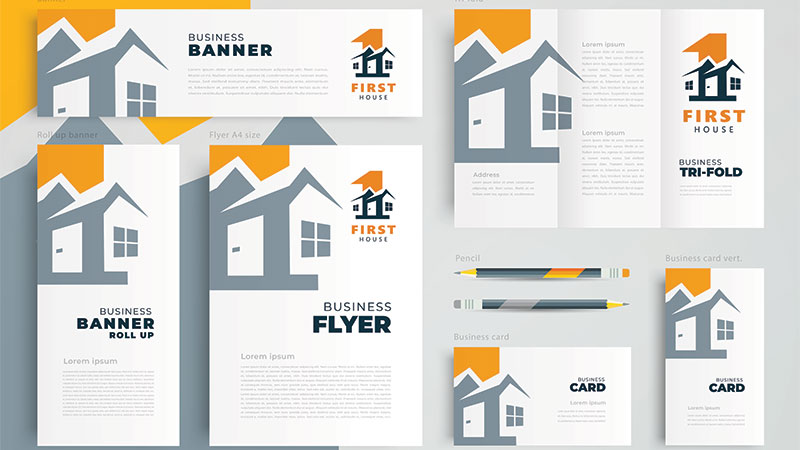
Vector Examples of Various Marketing Materials for Real Estate

Studies show that 79% of consumers consider actual mailing as a more convenient option than getting offers online. Using printed marketing materials for realtors in direct mailing, agents can hit two birds with one stone. Firstly, they can address offers to the precise target audience since they know the area they’re mailing. And secondly, print materials can also draw their prospects online. From this point, investing in print collateral makes perfect sense. Let’s look closer at some options.

Flyers, Postcards, Leaflets

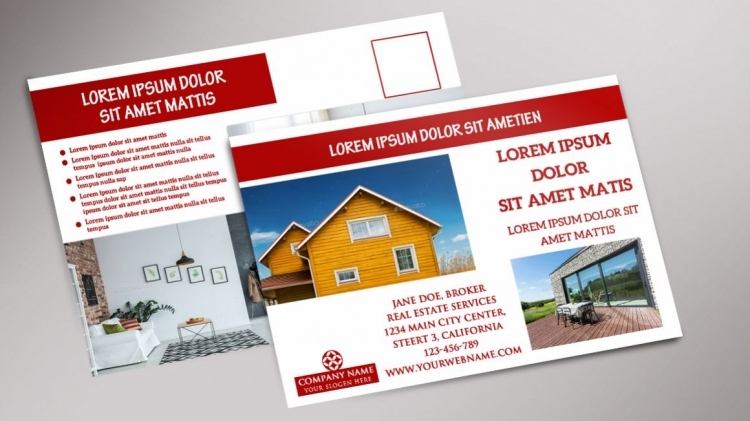
These materials are limited in size so they must contain the most important info , a striking CG image of a house, short description of real estate and area, prices, a QR code that leads to your website, or a promo code. Of course, such marketing materials should be eye-catching, punchy and deliver the message clearly.  

Real Estate Catalogs and Brochures

These marketing materials, in turn, are not limited in space so you can add more images , 3D visualizations of the house, 3D plans of each floor, panorama shots, etc. Make sure that each printed item is well-designed and has your logo on it, as well as your website and social media contacts. Put all of those materials in a mailing kit and add your business card to it.

Business Cards

Invest in creating a card that will stand out from the rest of the cards in the pile. For this, try to use non-standard materials, colors, and designs. We suggest trying a thicker matte paper and placing a small but catchy image on it , a 3D plan or a stunning outdoor pic. All in all, using creative solutions will make your business card memorable and effective.


Print goes further than paper, by the way. Magnets, tote bags and closing gifts all fall in the same budget line, and we listed the ones worth ordering in our rundown of real estate promotional items.

#5. Entertaining Video Blogs

A Real Estate Marketer Filming Video Materials for a Blog

Needless to say, the realtor’s personality really matters to prospects. They want to work with a reliable person who has a real customer base and reputation. Therefore, real estate agents must start building a personal image, and using vlogs is one of the most effective ways to do it. In a vlog, you can showcase the properties you work with, share tips on buying and selling a home, analyze the market and trends, educate customers on contracts, and so on.

If you are serious about vlogging, buy a good camera and equipment, and order first-class CG marketing materials for realtors to reinforce your vlogs. Those could be photos before and after virtual staging, properties after digital interior and exterior renovation, restyled homes, etc. Also, you can explain to customers how to explore houses virtually by using one of your 360° tours as an example.

#6. Buyer-Grabbing Online/Offline Ads

Virtual Staging as a Perfect Marketing Visual Material for Realtors

The most effective real estate campaigns juxtapose both online and print adverts to support one another. Regardless of the type of ad, it has to be based on compelling copy and jaw-dropping visual content. Thus, photos of empty houses simply won’t work here. 

For a terrific-looking print advert, a realtor can utilize images of a fully furnished house, welcoming home exteriors, a 3D plan, as well as a collage with an agent’s portrait. Such materials can be published in a magazine, local newspaper and used for outdoor advertising.

As for online ads, you can rely on the same static visuals and add slideshows of different properties. Also, try creating video ads with elements of your interview, customer feedback, and a virtual tour around the house.

Today, realtors have a plethora of options to improve their marketing , an effective website and social media, high-quality online and offline adverts, entertaining vlogs, etc. Real estate agents have to make sure their marketing CG materials are carefully designed and consist of impressive imagery of the property. This way, realtors will be able to draw the prospect’s attention to all their services, boost their visibility and tie together their online and offline presence.

Interested in stand-out marketing materials for realtors? Order virtual staging services from us now and get jaw-dropping CG solutions to outshine your competitors!

#7. Staged Listing Photos

Staging deserves its own line in that budget. An empty room photographs badly, full stop: it reads as smaller than it is, the proportions get lost, and buyers scrolling a grid of thumbnails simply skip it. Furnishing it digitally costs a fraction of renting real furniture and turns around in about two days, which is why it now sits in the standard package for a lot of agents rather than in the nice-to-have column.

Here is what that looks like on a real listing. Drag the divider and watch an empty room turn into something a buyer can picture living in. Same photo, same walls, same light, just furniture that was never physically there.

  • Before-111
    After-111
    Before 111 After

A bedroom version of the same trick, because empty bedrooms are the ones buyers struggle with most. Hard to tell whether a king bed fits when there is nothing on the floor to compare it to.

  • Before-Virtual Staging For A Cozy Bedroom
    After-Virtual Staging For A Cozy Bedroom
    Empty Space Virtual Staging For A Cozy Bedroom Furnished Bedroom

More before and after pairs live in our portfolio.

Realtor Marketing Materials FAQ

What marketing materials does a realtor actually need?

Less than the internet suggests. A site that loads fast on a phone, one social account you post to consistently, a set of listing photos that do not embarrass you, and something printed for open houses. That covers most agents. The trouble starts when someone buys ten tools and maintains none of them.

How much should an agent spend on marketing materials?

There is no rule, but the working numbers are humbler than people expect. Roughly a third of agents spend between 50 and 250 dollars a month on the tech side of their business. What matters more than the total is that it goes to two or three things you actually keep up, rather than a dozen half-finished profiles.

Do printed materials still work?

Yes, for the moments when someone is standing in front of you. Nobody finds your listing through a flyer anymore, but a decent brochure at an open house, a business card that does not look homemade, a postcard in a farm area, those still do work that a Facebook post cannot. Print is for the handshake, digital is for the search.

What makes a listing photo convert?

Light, staging and honesty, in that order. A bright furnished room beats a dim empty one every time in a grid of thumbnails, because the eye picks the picture it can read fastest. Just do not stage away the flaws people will see at the showing, because that turns a good first impression into a wasted afternoon.

Promo items for real estate: print marketing

Print marketing still plays an important role in on ground or guerrilla marketing campaign. Moreover, it is more effective for small real estate businesses with a focus on a local reach. It generates local brand awareness and leads clients directly to its premises. 

Digital ads disappear the second someone scrolls past. A fridge magnet with your number on it sits in a kitchen for years. That is the whole case for promotional items, and it is why agents working a specific neighborhood still order them by the box.

The trick is picking things people keep. Below are the print pieces and branded products that actually earn their spot in a local campaign, plus what to put on them so they do not go straight in the bin. For the digital side of the picture, see the wider marketing toolkit.

#1. Brochures

Promo items for real estate: Brochures

This kind of real estate promotional items have been a staple in the business for years and still are underway. They are tried and tested. People know what to expect. Brochures lend agencies authenticity and trustworthiness. They are quick and easy to create. Brochures provide potential clients with that sufficient data about the agency or persona to make a sound decision to collab. This is where the information should be given straight to the point and demonstrate the business generally.

#2. Business Сards

Promo items for real estate: Business cards

These real estate promotional items around and used in networking since the 17th century. They are still a powerful brand tool for realtors. They work ideally for encouraging referrals and word-of-mouth. It’s not a secret that successful realtors close more deals through referrals from previous clients.  A referral is most assessed by a new buyer or seller. Thus, new clients feel more confident when partnering up with a real estate agent recommended by a friend, family member, or a colleague. 

#3. Outdoor Advertising Objects

Promo items for real estate: Outdoor solutions

Ideal as real estate promotional items are outdoor advertising objects, such as billboards, city lights, scrolls, guerrilla and transit advertising, and so on. To create them, high-resolution print images are required. What’s interesting, it’s exactly 3D home staging that can handle such tasks. Not only does it allow any kind of visual content, but it also comes in any format and resolution, thanks to full-stack rendering capacities. So, it is a double win for two reasons: first, realtors can apply any visual and, second, expect it to be high-quality. 

#4. Banners

Exterior and Landscape Visualization for a Mansion

At some point, real estate business needs such real estate promotional items as banners. The latter might come in handy for trade shows, agency’s events, and so on. Luckily, nowadays different advancements in printing methods like variable data printing significantly decrease costs. Besides, banners are reusable and eye-catching. Nowadays, the most progressive agencies use computer-generated images for that. 

The technology allows staging living spaces virtually like adding furnishings and creating real-life designs and applying them to any print promo item. Why is it pivotal? This way, banners become specific message carriers to appeal to a certain target audience at the event or demographics in the neighborhood.

#5. Postcards, Leaflets For Mailing

Content for mailing

Sending out postcards or leaflets within a new promotional campaign is an excellent way to inform people of new opportunities. If the tactile quality of these real estate promotional items taps into people’s ‘haptic (touch) memory’, they build an emotional connection with them. People are more likely to take time to read through it. High-quality print especially makes sense for luxury real estate newsletters. 

Be the way, this kind of material can be also enhanced with cg imagery and virtual staging. Again, if realtors know well their target audience, they can include particular virtually staged interior scenes to build more meaningful connections with the readers ‘from the first sight’. 

Print marketing is still mainstream in the industry. Elaborate real estate promotional items make it stand out and even outshine some digital strategies. However, virtual staging and cg imagery, in general, play a crucial role here as well. They make a  marketing campaign personal, memorable, and tangible. CG images are as realistic as photos, yet require less time to be prepared, allows more creativity and customization, and, what’s more important, work with any format and platform. They are reusable and multipurpose. Together with a digital one, it constitutes a killer sale power for agencies.

Willing to use virtual staging services for your real estate promotional items? Pitch out team right now and get a quick glimpse into how to turn your promo materials into sales machines right now.


Printed materials work better with furnished interiors on them, and CG staging is the quickest way to get those shots.

#6. Branded Merchandise That People Keep

Branded merchandise is where most of the promotional budget goes, and where most of it gets wasted. Nobody keeps a cheap pen. They do keep a solid tote bag, a decent notebook, a magnet with a local sports schedule printed next to your logo, a bottle opener shaped like a house. The rule of thumb is simple: if you would not use it yourself, it ends up in a drawer.

#7. Closing Gifts

Closing gifts sit in a category of their own. This is the one item a client photographs and posts, so it earns referrals long after the deal. A cutting board with the address engraved, a good doormat, a framed photo of the house on handover day. Skip the branded mug here. The gift should feel personal, and your name on the card is enough advertising.

#8. The Photos You Print

One practical note on artwork. Whatever you print, the property photos on it need to look like the listing did online, which usually means the same staged images you used there. A brochure with an empty room next to a website full of furnished ones just confuses people who saw both. If the rooms were empty, virtual staging fixes that before anything goes to the printer.

Real Estate Promotional Items FAQ

What promotional items work best for real estate agents?

The boring ones, mostly. Magnets stay on fridges, tote bags get reused for groceries, notepads sit by the phone. All three keep your number in sight for months. Novelty items get a laugh and then a bin. If the budget is tight, pick one useful thing and order it properly rather than three cheap ones.

How much should an agent spend on promotional products?

Most agents working a neighborhood spend a few hundred dollars a year on this, not thousands. The number matters less than the split: something to hand out at open houses, something worth keeping for past clients, and enough left over to reprint when the phone number changes.

Do printed brochures still generate leads?

They do, but not the way a website does. Nobody googles their way to a brochure. It works when it is in someone hand at a viewing, or in a mailbox on a street where you already sold something. Treat print as a local reminder, not a lead generator, and it starts to make sense.

What should go on a real estate promotional item?

Your name, one number people can actually call, and a photo worth looking at. That last part is where most items fail. A grainy shot of an empty room does you no favors on glossy paper. Use the same staged photos from the listing so the piece matches what people saw online.

A Realtor Giving a Key from a House to a Buyer

Anyone who is starting a business in the property market wants it to break even as fast as possible. New real estate agencies have no time to experiment to find out what works and what doesn’t. Luckily, there are efficient working strategies that are tried and tested. An aspiring real estate agent should implement them to succeed in the property market. Read more

Real Estate Photos Before and After Virtual Staging

Usually, when dealing with vacant homes, realtors have to furnish them first to make them look homey and worth buying. In such cases, many agents choose CGI over physical staging. The reason why they opt for virtual staging for real estate photos is that CG imagery is an effortless and fast solution. See for yourself, they don’t need to rent and transport the furniture, as well as hire movers, a staging agency and photographer. They simply take high-resolution photos of the home, send them to a virtual staging studio – and in just 48 hours the property is fully furnished and ready for sale! Read more

Tips on the Best Visuals for Facebook Ads that a Realtor Can Use

These days, all realtors have Facebook profiles, and some of them have succeeded in growing an impressive number of followers. Since there are so many brokers and agents on the internet, one has to try very hard to stand out among their competitors. An eye-catching ad could be a very effective way to gain more followers and drive potential customers to one’s website. Is there a secret of the best Facebook ads for realtors? Read more

A Bedroom Photo Improved in Real Estate Editing Software

In order to draw the attention of modern prospects to real estate offers, realtors and brokers cannot go for anything less than Instagram-worthy photos in their listings. There’s simply no other way to stand out from thousands of competitors on the same platforms. What one needs to know in order to get amazing images is that they have two options that both include photo editing software for real estate.  Read more

CGI of Modern Open Kitchen Ready to Be Used for Real Estate Listings

Many realtors and real estate brokers use CGI in real estate marketing and promo. Understandably so, this technology does miracles to property pictures as it allows filling empty homes with furniture, improving finishings, and even completely renovating houses virtually.   Read more

Virtual Interior Design for an Apartment that Was Made With 3D Modeling and Rendering Processes

Selling an empty house could be tricky even for experienced realtors. Since such a property demonstration lacks attractive features and doesn’t look homey, prospects often pass by. For the better presentation of the house, an agent has to find a way to furnish it with stylish items and decor. They can hire an interior decorator for physical furniture staging or go through the virtual interior design process.  Read more